

Neet Shah
March 2019
8 min read
Good customer service is a crucial element in customer retention, but in-house contact centers can be one of a company's largest expenses. Outsourcing customer service to off-shore companies will substantially reduce costs, but at the risk of customer resentment and dissatisfaction. A middle-ground alternative is Home-Based Servicing (HBS). HBS can offer customer service quality on par with a brick-and-mortar call center, but at a substantially reduced cost.
Not too long ago, HBS was the domain of third-party vendors. The evolution of telecommuting capabilities offers organizations more flexibility than ever in evaluating HBS as a cost-reduction option. Whether partnering with a vendor or equipping existing employees with remote work options, there are some key considerations to successfully implementing your virtual contact center.
Training: Proper training is critical in implementing an effective HBS solution, and most companies considering HBS state that training is their biggest concern. While 90% of brick-and-mortar training is classroom-based, HBS relies on virtual training. Virtual agents will require some additional content above and beyond that offered in traditional brick-and-mortar settings. Most of the additional content will focus on the special skills that virtual agents must master, including:
Time management, since HBS agents lack external structure and supervision.
Communication tools for distance collaboration.
Disaster recovery for dealing with agent computer crashes and other technical difficulties.
Recruiting/Screening. Given that most (if not all) HBS agent recruitment will be virtual, a far more rigorous screening process will be necessary than that required in traditional brick-and-mortar centers.
The profile of the ideal HBS candidate is substantially different from that of a brick-and-mortar candidate. HBS candidates typically are more educated and experienced than brick-and-mortar reps. Compensation for a home-based agent falls somewhere in between a brick-and-mortar agent and an offshore agent, which we'll cover in greater detail in a moment.
Technology. Our research indicates that most companies without HBS agents already have 60% of the required technology infrastructure to support remote agents. The components which will require the most scrutiny are phone configuration, workstation configuration, Private Branch Exchange (PBX) setup, and application server setup. The technical support of HBS agents remains a constant and ever-growing need as more remote-friendly technologies emerge. Innovations like VR office environments herald an increasing dependence on strong technological infrastructure and support to make home-base servicing viable for your organization.
Operations. Most HBS vendors create proprietary software to manage all aspects of the virtual workforce. Many bundle scheduling, communication, call routing, forecasting, coaching and agent ranking functionality into a single application. An effective workforce management tool will be able to:
Create agent work schedules
Assign agents optimally to schedules
Monitor each agent's adherence to schedules
Facilitate communication about scheduling
Communication. The virtual contact center requires a non-traditional style of management due to the lack of onsite supervision. Some contact centers require an initiation period during which new agents work on site to become familiar with products and procedures before establishing their remote offices. Also, most contact centers use monitoring and workforce management tools to aid in scheduling, and verify agent performance and call-handling metrics.
Virtual agents must have robust communication tools that allow them to communicate freely with other agents/managers while still on the phone. HBS vendors often integrate collaboration (interactive participation) and presence (the ability to see where your colleagues are) into the communication framework.
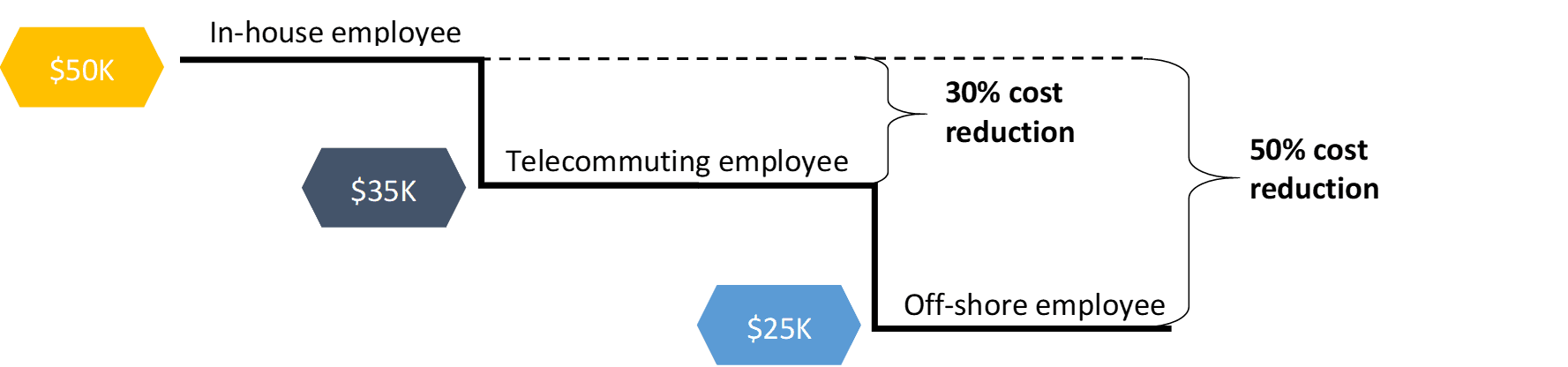
Full-time telecommuting can save approximately $10,000 per employee per year. Assuming a fully-loaded customer service rep costs about $50K (including real estate needed to staff this individual in an office), we can reasonably suppose a minimum of 20% savings for home-based. Add in the benefits of flexible scheduling, increased productivity, and lower attrition, and a total savings estimate could be closer to 30%.
What about comparing telecommuting to a fully offshore arrangement? A similar story emerges in a strict comparison of Salary & Benefits (S&B) costs between in-house, telecommuting, and offshore employees. For illustrative purposes we'll make a few assumptions, namely:
The primary savings for a fully offshore service center is Salary & Benefits (S&B)
A U.S. customer service rep's S&B alone in the US might be approx. $40K/year
Thus, S&B for an offshore solution in a place like India would likely be closer to $10K/year. Factoring in extra costs for technology, training, and other miscellaneous associated expenses, let's assume net savings of $25K less than in-house, or a cost reduction of about 50%.
These considerations already make a compelling case for implementing remote customer servicing. The benefits are not strictly cost-related, however. Additional benefits beyond cost savings might be:
Diversity
Many companies now have very explicit targets for diversity. This includes women (particularly women returning to work after childbirth), veterans, and physically handicapped people. HBS is potentially a good way to enable companies to meet their diversity targets.
Business continuity
Having a larger percentage of your agents based at home gives you better Business Continuity in the event of major storms or other natural events. A large company may have 3-4 major contact centers in the US. A storm can knock 1-2 of these out and eliminate 25-50% of capacity. HBS is a good way to reduce this.
24-hour service
A robust staff of telecommuting agents could offer coast-to-coast contacts. Additionally, eliminating traffic commutes from a workday may give employees greater willingness to work earlier or later hours.
Better coverage for seasonal/daily service spikes
Employees working from home may have the ability to just log on for a couple of hours when higher call volumes are expected.
Larger labor pool
HBS improves your ability to staff top talent that may not be in your town/city.
Reduced attrition
Onshore call centers can experience attrition rates of 20-30% per annum, with offshore potentially double that. In contrast, attrition rates for home-based reps are typically under 10%. Beyond the cost impact, lower attrition generally results in improved customer and employee satisfaction and improved quality level.
Before deciding on whether to send your employees home or partner with an HBS vendor, perform a thorough analysis of your HBS capabilities, along with a benchmark against current best practices. Even if your ultimate goal is to run HBS in-house, using a vendor to test out the process could act as a soft entry.
It's never been easier to incorporate HBS practices into your call-center operations, offering customer service on par with an in-house contact center and numerous other benefits beyond cost reduction. However, employing the HBS model is not a simple matter of converting training materials and extending existing brick-and-mortar practices. It requires careful consideration and planning for recruiting, training, operations, technology and partner selection.

Neet Shah
Published
March 2019
Reading time
8 min read
Topics
Work with FischerJordan
Our experts are available to discuss how these insights apply to your organization.