Neeyati & Anmol
March 2024
10 min read
This article appeared in Technology Dispatch.
Technological shifts have historically marked significant divisions in time, from stone tools to smartphones. Now, as we stand on the cusp of another defining era with Large Language Models (LLMs), questions about their potential to replace human roles are rampant.
In this article, we delve into the impact of LLMs on the global economy by:
1
Considering three key metrics and exploring insights through different economic lenses.
a. Productivity (as measured by real GDP growth rate)
b. Job displacement (as measured by unemployment rates)
c. Development categorisations (whether a country is advanced, developing or developed)
2
Assessing the change in the magnitude of impact as we start on an economy-wide level and zero in on the industries and finally individual occupations.
LLMs are advanced AI algorithms that leverage deep learning and vast data sets to generate, understand, summarize, and predict content. For example, ChatGPT is a prominent LLM that can produce human-like text instantly based on prompts (TechTarget).
ChatGPT's rapid growth, gaining 1 million users in just 5 days, has stirred concerns about job security. Previously untouched by technology, creative arts jobs seemed immune due to their emotional nature. However, LLMs have introduced unexpected shifts.
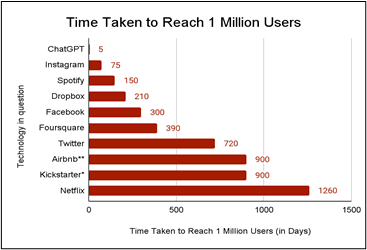
Chart 1
Globally, ChatGPT automates tasks in logistics, recruitment, and customer service. While concerns exist, the World Economic Forum predicts growth in roles like Business Intelligence and Information Security Analysts. Though routine roles may decline, net job growth is projected. ChatGPT's all-encompassing potential as a General Purpose Technology and its ability to perform cognitive tasks raise concerns about job displacement. Yet, it also offers augmentation rather than replacement. New jobs, like prompt generators and AI trainers, emerge as automation advances, demanding innovation for idea generation. With the initial disruption settling, new opportunities arise. The impact of LLMs leans toward displacing labour, creating roles that balance automation and creativity. The future involves leveraging AI ethically, and job roles like AI trainers and data scientists are pivotal in shaping this transition. Thus, LLMs reshape job landscapes, emphasizing both displacement and potential for novel roles.
To glean a greater understanding of the same, we look at the correlation between interest in ChatGPT (used as a proxy for adoption) and the real GDP growth figures for 2022-23 and 2024-25.
We see that the correlation coefficient between interest in adoption and current GDP (2022-23) growth rates is -0.119. On the other hand, we see that the correlation coefficient between interest in adoption and forecasted future GDP (2024-25) growth rates is -0.138. Given these figures, on the level of the world, there is no correlation or a very weak negative correlation.
Due to the newness of the technology and limited data, our current reporting lacks a clear definition. Yet, we believe valuable insights can still be extracted from the existing but incomplete data. It's crucial to recognize that the adoption of technology takes time; for instance, Fogel's Nobel-winning study on Railways revealed that their influence on American prosperity wasn't immediate, but rather emerged nearly a century later.
In a vein similar to the analysis undertaken above, we once again look at the correlation between interest in adoption and unemployment rates. While the data processing for the former remains the same, we extract data for the latter using the World Bank's open-access data sources. Again, the dataset reveals no correlation (0.047).
Recognizing the limitations of global correlation coefficients, we delve into the nuances of different country groupings. This approach unveils disparities stemming from varying development experiences. Major advanced economies undergo scrutiny to determine if their economic advancement yields distinct results. We also assess their performance relative to each other and the global average. Our analysis extends to emerging market economies and densely populated regions. This enables us to gauge how the technology affects areas abundant in labour and still developing.
The table below summarises the findings (for detailed calculations refer to the Excel attached in the appendix):
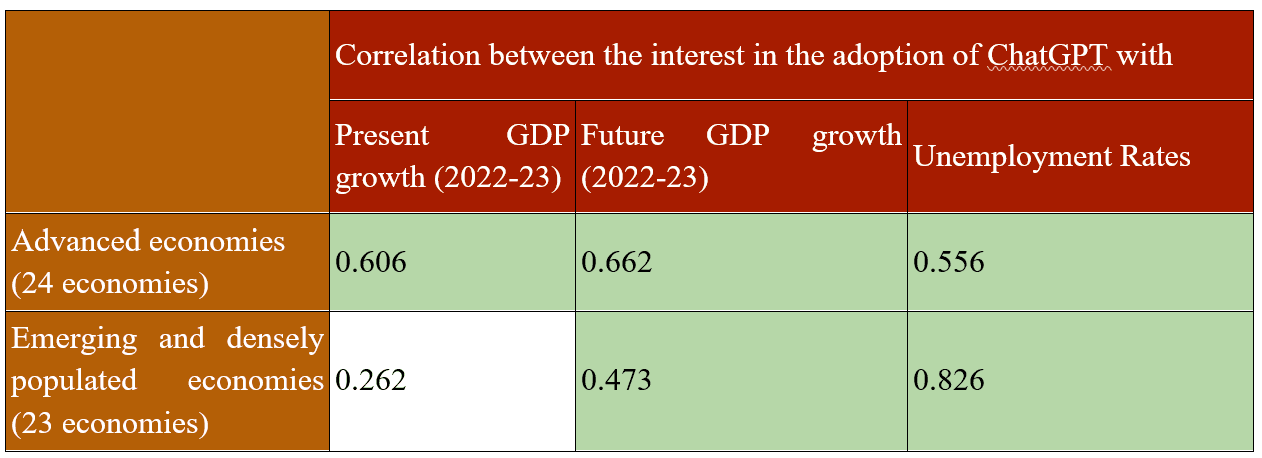
Table 1 – Summary of Correlation Coefficients
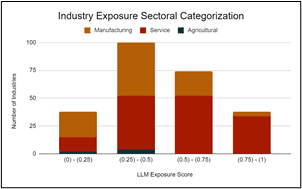
Chart 2
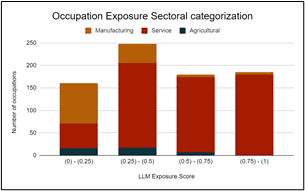
Chart 3
While the service sector predominantly experiences the highest impact among industries (as shown by chart 2), a closer examination of the combined histograms highlights that the influence on industries is overshadowed by the effect on occupations (chart 3), once again emphasizing the greater impact on unemployment than on GDP.
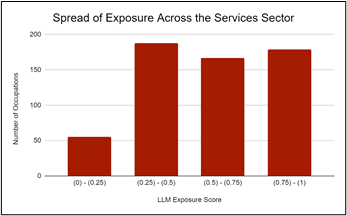
Chart 4
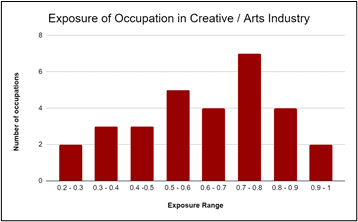
Chart 5
For example (Depiction of two examples on either side of the spectrum using chart 5):
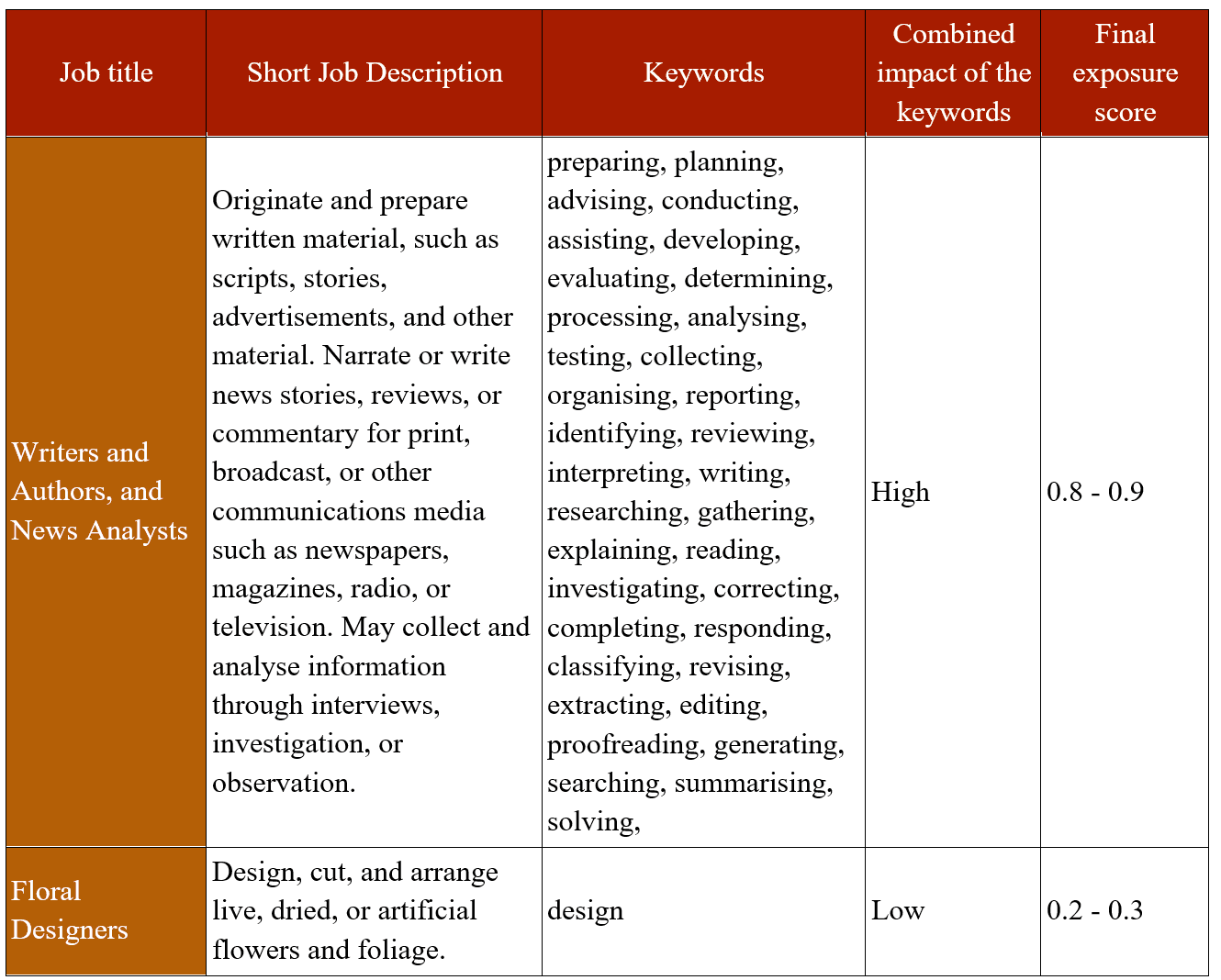
For example (Depiction of two examples on either side of the spectrum using chart 5):
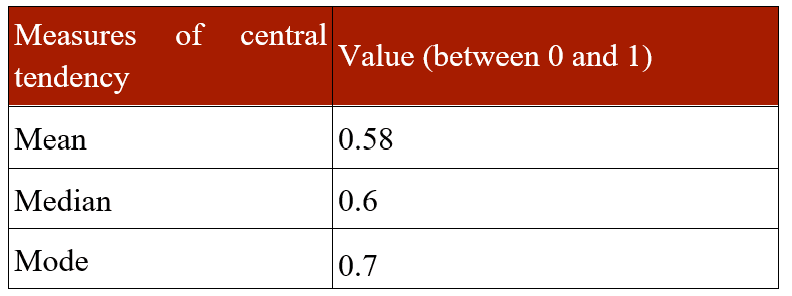
Table 3
These charts and tables have an interesting interpretation. A mode of 0.7 tells us that in terms of sheer numbers, a significant number of jobs out of the sample can be automated. However, a mean of 0.58 takes into account the degree of automation. Say, for example, we look at the jobs of three workers in the creative sector whose jobs will be impacted by ChatGPT – writers, editors, and craft artists. However, we could easily illustrate the degree of job exposure for each professional as follows: writers > editors > craft artists. Now, writers and editors are more easily replaceable, and, thus, on an individual level, there is a high job replaceability for writers and editors. Craft artists (craft, not visual), on the other hand, barely bear the brunt of this technology. So, precisely because of these reasons, the industry impact remains low in terms of the net values (as shown by the mean) even as the impact of ChatGPT on individual jobs that are more susceptible to technological advancements remains high (as shown by a mode of 0.7).
We extrapolate the results of this industry to the entire service sector, now which helps us come back to Chart 4. The U-shape of the bars tells us that when taken as a sector, there's relatively little impact of automation on the global front (hence the even spread without skew). However, on a more granular, individual job level, there are greater repercussions.
1. Data Constraints and Novelty
Limited datasets and technology's newness hinder the precise evaluation of ChatGPT's global productivity and employment impact.
2. Potential Inequalities
LLM adoption may magnify disparities between developed and developing economies. Capital-intensive advanced economies experience positive GDP growth correlation with ChatGPT, suggesting labour augmentation. Labour-intensive emerging markets face displacement, with varied labour-saving or -displacing effects.
3. Labor Dynamics
Advanced economies see augmented labour productivity from LLMs while emerging markets witness displacement. Impact levels align with economic development.
4. Industry vs. Individual Influence
LLMs affect industries less significantly compared to individual roles, emphasizing nuanced outcomes.
As data evolves, deeper insights into LLMs' global economic impact will emerge.
1. Addressing Inequality and Challenges of LLMs
The analysis highlights a potential widening of inequality due to LLM adoption. Advanced nations benefit while developing nations face challenges. Individual job impacts also vary disproportionately, potentially exacerbating economic disparities.
2. Institutional Preparedness
To mitigate this, robust institutions are crucial. Equitable wealth redistribution policies and infrastructure are needed without undermining market incentives. Collaborative efforts between governments and corporations are vital for collective prosperity.
3. Balancing Technology's Impact
ChatGPT's impact isn't inherently positive or negative. Used wisely, it can democratize discourse, enabling broader participation. However, productivity gains may not guarantee overall well-being, reminiscent of smartphones causing distraction and altering brain chemistry.
4. Opportunities and Trials
ChatGPT offers productivity gains and the potential for shorter workweeks. Yet, challenges emerge. Test runs like Gandalf 'S' Adventure address data breaches from LLM-email integration. Ethics and copyright issues arise in AI-made art. Integration in communication tech questions authenticity and relationships in this new paradigm.
5. Awaiting the Unfoldment
As the communication landscape evolves, we hope for inclusivity. The true impact of this revolution is yet unknown, emphasizing the need to navigate challenges and opportunities with the best interests of society in mind.
[1]
Felten, Edward W. and Raj, Manav and Seamans, Robert, How will Language Modelers like ChatGPT Affect Occupations and Industries? (March 1, 2023). Available at SSRN: ssrn.com/abstract=4375268 or doi.org/10.2139/ssrn.4375268
[2]
Zarifhonarvar, Ali, Economics of ChatGPT: A Labor Market View on the Occupational Impact of Artificial Intelligence (February 7, 2023). Available at SSRN: ssrn.com/abstract=4350925 or doi.org/10.2139/ssrn.4350925

Neeyati & Anmol
Published
March 2024
Reading time
10 min read
Topics
Work with FischerJordan
Our experts are available to discuss how these insights apply to your organization.